Aug 18, 2009 0
Jun 25, 2009 1
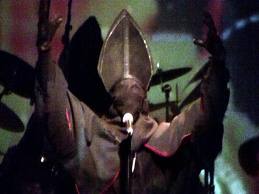
The Joker
I may be late to the party, but I always have a good time.
See, I final caught Heath Ledger’s swan song in The Dark Knight and, like many people, his performance as the Joker really got under my skin.
Weird, damaged, and menacingly off-kilter, Ledger’s Joker embodies everything that Western rationalism apparently opposes and inevitably calls forth.
Unlike those shadowy figures who are thus labeled, this Joker is a terrorist in the most literal sense of the word: his sole aim is the production of a blithely dehumanizing, sanity annihilating, shockingly atavistic terror, specifically, the terror evoked by abject encounters with the chaotic void from which all reality issues and to which it inexorably returns.
The film gets evil precisely right when the Joker says, “The only sensible way to live in this world is without rules.” From the standpoint of law and order, in either a secular or non-secular sense, the idea that there is no absolute line dividing right from wrong or good from evil is intolerable. To celebrate those acts condemned by the dominant system leaves its hierarchy of values in place; to reject the legitimacy of any hierarchy at all is satanic rebellion.
(On a side note, I hear in the Joker’s ethos the pragmatic view that an unconditional flexibility – no fixed, dogmatic rules – provides the key to adaptive survival. Of course, the amorality of adaptation, which is really just an opportunistic and even accidental “going with the flow,” is what truly frightens opponents of evolutionary theory.)
The film gets chaos precisely wrong. The violence and mayhem orchestrated by the Joker undeniably reflects the pervading notion of chaos as unpredictable, unassimilable, and overwhelming activity, but therein lies its error. True disorder is not characterized by a lot of something happening, but rather by a lot of nothing happening.
Indeed, the most accurate image of chaos we can muster is the heat death which awaits us as the entropic end of it all. When there is no longer any difference in energy states anywhere in the universe the pure state of chaos has been attained and it is, by definition, indistinguishable from nothingness. (Of course, this is why reviewers were unanimous in designating the Joker’s worldview “nihilistic.”)
By taking the side of the entropic decay and unstoppable disintegration of order, the Joker aligns himself with the grinding momentum of reality itself. It’s also why he is, as he says, “ahead of the curve,” and always one step ahead of Batman and the police; reality’s motion, its long march towards total dissolution is always one step ahead of us. We can never overtake it and are always, in the end and even before, overtaken.
Yet, it is this fact, the ultimate source of the Joker’s power, which also makes Batman’s adherence to his “one rule” truly heroic, though in the tragic sense. Belief in the timeless and unquestionable validity of “the rule” requires the denial of reality (that all rules are provisional, conventional, mutable ) and is, insofar, utter folly. Nevertheless, the faith expressed in devotion to “the rule” constitutes the stuff of valor and is, therewith, utterly human.
This raises the very question posed insistently and insidiously by the Joker as envisioned by Heath Ledger:
Does the unblinking acceptance of reality call for the overcoming of our humanity?
And if it does, should we?
Image Courtesy of Joan Thewlis.
Jun 3, 2009 2
What Do You Want to Do with Your Life?
My posts on Aquent’s blog sometimes got kind of philosophical. Here’s an example which should help you dodge the question, “What do you want to do with your life?” It first appeared on September 20, 2008. – Matt
About twenty years ago, after I had stopped out of grad school, quit my job at SuperShuttle, and was so broke that I made all my family members collages as Christmas presents, my father sat me down for a fireside chat. The gist was: Dude, you got to get it together, figure out what you want to do with your life, and just do it. The problem was, as he put it, “You don’t seem to do anything.”
Was I a lost soul at that point? I suppose I was. My band (Spanking Machine) wasn’t going anywhere, I was unemployed, and, frankly, very depressed. When I returned to San Francisco from that demoralizing holiday in Los Angeles, I got a temp job (thus launching my current career, oddly enough) and wrote my father a letter.
Aside from the fact that the main point of the letter was to ask him for money so I could fix my car (yes, I did that), I also took issue with his criticism of my do-nothing lifestyle. On the one hand, as I pointed out, I did actually do stuff like write page after page of mad-cap, beatnik musings, play music, and hang out with my friends. I also reminded him that there were quite a few cultural and spiritual traditions that emphasized doing nothing over doing something as the true goal of life and enlightenment and that I was not unsympathetic to such views. Moreover, the idea that our lives and the world at large were there as a resource for us to do something with was symptomatic of the Zeitgeist, as Martin Heidegger explained in his essay concerning the question of technology.
Here’s where it gets deep (so watch out). To this very day I bristle at the existential imperative, whether in secular or religious garb, that says you have to do something with your life. There are so many things that are wrong-headed about this notion that I don’t know where to start (or finish), so I’ll just highlight two logical inconsistencies that dog this everyday ethical commonplace.
First of all, “your life.” Aside from the fact that even scientists struggle to define life, what exactly about the life you live is yours? You are, after all, 90% water, which, if I understand it properly, is made of hydrogen and oxygen that has been part of this earth for some billions of years. Add to that the carbon, nitrogen, and other trace elements comprising you as physical entity, you quickly realize that none of them are “yours” strictly speaking. Indeed, your genetic peculiarities are a melange of your father’s and mother’s, as their’s were of their’s, and, in any event, consist of amino acids that are of rather ancient provenance. Etc.
So, the living matter provisionally associated with your life is freely borrowed from the environment and the vast surrounding universe to which it will inevitably return (yes, I’m referring to “your” death). But what about this “you” that is supposed to “do” something with this “life.” First of all, your “you-ness” is inextricably linked to this particular physical entity that perpetually changes (replacing itself every seven years or something like that). Not only that, your sense of yourself, your personality quirks, and your interests are totally contingent on your genetic makeup, your lived experience, and your physical condition. If you doubt this, please experiment with severe brain trauma and review the results.
But turning away from the impermanence and ineffability of your you-ness, how could you do anything with your life in the first place? Usually, in order to do something with anything, you need to distinguish between you and that something. But how can you stand outside your own life which, as we know, is not a thing in the first place? And if people mean, “Create an interesting story or artwork from the events and experiences of your life,” when they say, “Do something with your life,” why don’t they just say that?
Because, frankly, they don’t mean that. They mean, “Do things as part of your life that, retroactively, will have made your life a meaningful something instead of a meaningless nothing.” But, as everyone knows, “meaning” is entirely contextual. Nothing means anything in isolation. Which means that you can never be the judge of whether or not your own life is or was meaningful. That can only be decided by deciders who stand outside of your life and understand all its ramifications, not just in your little world, but in the history of the universe. And the number of deciders who are in a position to do that are either zero, one, or three, depending on your persuasion, none of whom are you, or even human, for that matter.
If you’ve read this far, you get the picture. From here on out, whenever anyone tells you to do something with your life, and you don’t have the time or wherewithal to explain to them what’s wrong with that statement, please have them contact me, and I’ll do the dirty work.
Image Courtesy of mohammadali.
Apr 11, 2009 0
The Consolations of Conspiracy Theory
Ever since I realized that there was an “official story,” on the one hand, and a very complicated, to some degree unknowable, and to some degree intentionally obscured, reality on the other, I’ve been interested in conspiracy theories. From Holy Blood, Holy Grail to Loose Change, from occult Nazism to the reign of the reptoids, I’ve consistently been amused, amazed, and disturbed by the fantastic proliferation of alternative world histories and astonishing speculation about who’s really running things.
I’ve always tended to approach these theories with a Muldaurian “I want to believe” attitude, but have also always been disappointed when I dug down into the details. While it may be true that I’ve never met a conspiracy theory I didn’t like, it’s also true that I’ve never met a conspiracy theory that wasn’t riddled with holes, hallucinations, and brain-rending leaps of (il)logic. Reading this stuff has frequently been edifying and even, in a strange way, inspiring, but it has never been convincing.
Although the truth is undoubtedly out there, conspiracy theories are not about the truth. Their primary purpose is to forge a semblance of order from the relentless rush and incomprehensible sweep of events on both the human and cosmic scale. Scientific discovery has unveiled a universe of overwhelming temporal and spatial vastness, the mass media continually inundate us with an unassimilable torrent of devestating reports from the bottomless well of human suffering, and the traditional (i.e., religious or mythical) filters no longer have the power to channel our experience into comforting or even remotely manageable frames of reference.
Still, the thought that our lives are “meaningless commas in the sentence of time,” or that we are blindly stumbling, ‘neath a protective veil of self-deception, through a labyrinthine vortex of genetically driven ego-trips and Nietzschean/Orwellian power-games devoid of exit or purpose, is for most of us unbearable. So we clutch at the straws offered by the conspiracy theorists (not to mention the good old news) because they tell us that, even if it is the Greys or the Illuminati or the CIA or the World Bank or the Council on Foreign Relations or the Trilateral Commission, or whatever, at least SOMEONE is in charge and everything is at least going according to SOME plan, as nefarious, diabolical, or alien as that plan may be.
The question is: Why are we consoled by the thought of SOMETHING, even SOMETHING MALEVOLENT, behind EVERYTHING?
Why, on the contrary, is the notion that all we are and experience arises from and inevitably returns to a primordial, entropic chaos – in other words, to nothingness – so difficult, even impossible, to accept let alone embrace?
Or is it?
Image Courtesy of Midnight-digital.