Matthew T Grant

Icon

Tall Guy. Glasses.

The Really Real, Totally Authentic Thing

2385429026_062f5691ef_mIf you don’t have time to blog then don’t. Ghost blogging is inauthentic & the antithesis of everything social. #dontbeafake cc @mitchjoelAvinash Kaushik

When I was in graduate school, there was a lot of talk about the “death of the author.” Such talk was driven primarily by French, post-structuralist thinkers like Barthes, Foucault, Derrida, Deleuze, and Lacan who had an intensely nuanced and complex notion of writing and authorship that tended to highlight the supra-personal in any putatively “personal” utterance or authorial gesture. Steeped in such thinking, I became very skeptical of attempts to say with certainty who the “who” is when we ask, “Who wrote this?”

Barthes et al. were responding to various French philosophical currents of the 20th century but especially, I believe, existentialism. Whereas existentialism had put the individual human being at the center of (an ultimately meaningless) existence, thus hoping to establish a new moral center following the death of God, the post-structuralists chose instead to show that the individual was not the center of anything but, rather, the effect of many things (language, culture, discourse, the unconscious, etc.).

The French were not the first or the only critics to suggest that the individual (sometimes called “the subject”) was epiphenomenal. Freud had certainly pointed in this direction when developing his psycho-analytic theories as had Nietzsche a decade or so before him, Marx a decade or so before that, and Hegel at the very outset of the 19th century. But even these gentlemen were not the first to insist on the essentially contingent nature of individual identity which, in one form or another, can be traced back to the teachings of Buddha and even the Vedic authors before him.

Which is all to say that when I read things like Mitch Joel’s recent blog post on “ghost blogging,” my philosophical buttons get pushed.

Conceding that there may be practical value to ghost blogging (“I get that people Ghost Blog and it works”), Mitch shows that his opposition to it is, more than anything else, a matter of faith. Like a Luther for the Twitterati, he writes, “I believe this one thought (and I will stand by it): corporate Blogs being presented as a personal space to share insights have a predisposed and inherent understanding that the person whose name is on it is the actual author.”

You see, Mitch is less concerned with the value of ghost blogging than he is with values or, as he puts it, “ideals” (“I do think that there are some commonly held ideals within Social Media”) which he also refers to as the “pillars of what makes something ‘social’.” These pillars being, “transparency, openness, honesty, human and real voices (not corporate mumbo jumbo) and a culture that embraces sharing between these real voices.”

In other words, Mitch is a moralist who even indulges in the classic rhetorical move of the moralist, the value-laden leading question: “Why is everyone who defends ghost blogging so afraid to state that ghost blogging’s first act is one of deceit and misdirection?”

The philosopher in me wishes merely to point out that expressions like “actual author,” “real voices,” “human,” “social” and so on are not unproblematic.

What, after all, is an author and how does an author, generally speaking, differ from an “actual” author? What makes a voice “real,” particularly when we are talking about written texts (blogs) where the notion of “voice” itself is metaphorical? What attributes belong to the category “human” and what happens when “humanness” is invoked as an ethical category? Since when is the “social” defined by “honesty, transparency, and openness” rather than by concepts like “convention” or “conflict”? Etc.

I’m not sure that Mitch Joel is interested in the history of philosophy, let alone the history of the “ideals” that he invokes. Indeed, I’m fairly certain that he would dismiss my argument—that, in essence, concepts like authorship, or authenticity for that matter, are over-determined, social constructs which in no way represent uncontested, universal values—as equivocation. I am, after all, a ghost blogger whose work goes undisclosed by my clients. Thus, in the eyes of Mitch Joel, Avinash Kaushik, and others, I’m an aider and abettor of unreconstructed frauds and deceivers.

In my “defense,” and in answer to Mitch’s inherently unanswerable question (shades of “How frequently do you beat your wife?”), I would say that, if I am afraid to state that my first act every morning is one of deceit and misdirection, it is because I fear saying something that I do not consider to be true. Rightly or wrongly, I actually believe that the people whose bloggings I facilitate are the “actual” authors of the posts that I produce. The ideas are theirs, the “voice” is theirs, the blog is theirs, etc.

That being said, on a “human” level I resent the jargon of authenticity which pervades social media. When someone says, in the imperative voice, “Don’t be a fake,” I bristle. Why? Because I find the division of human actions into “real” and “fake” itself dehumanizing. Where does the notion of “authenticity” come from anyway? It is a term of trade driven by the desire to differentiate the genuine from the counterfeit so that an item can be assigned a monetary value. “Authentically human” is just another way of saying “Genuine leather.”

When we demand that humans be “authentic,” or criticize them for being fake, it’s because we have reduced them to the status of commodities. In fact, I believe that the social media, rather than humanizing marketing, as Mitch Joel and others have long hoped, have in fact completed the total colonization of human thought and affect by market forces.

Given the absolute assimilation of our lives by the new media, down to the most trivial whims (“I just ate a donut covered in bacon!” “I hate Justin Bieber”), isn’t it possible that the only way to hang on to our humanity is through masks, personae, and “ghosts”?

Or, in the immortal words of Robert Plant, “When you fake it, baby, please, fake it right.”

Image Source: Nick Wheeler.

Share

Atheism

2233489406_c73b1f9751_m

God is dead. – Nietzsche
Nietzsche is dead. – God

In America, and apparently some parts of the developing world, it can be very shocking when you tell people that you do not believe in God. Indeed, even among America’s educated classes, you’ll rarely hear an expression of outright atheism (though you will encounter a fair amount of agnosticism).

I asked a friend once why this was and he replied, in effect, that people claim to be agnostic mainly because they are cowards. At first I thought he meant that they, like Pascal, were basically hedging their bets. I mean, what if they’re wrong? Better not to commit either way.

Now I believe that he was pointing instead to their fear of communal opprobrium. Agnostics don’t fear God, after all (if they did, they wouldn’t be agnostics). The only thing they have to fear is Believers.

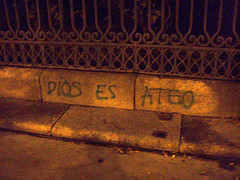
For my part, I’ve tended to be fairly forthright about my atheism. I do not believe that God exists. At the same time, being of a rather philosophical bent, I’m not entirely comfortable with that manner of expressing things. Why? Well, it all depends on what your definition of “is” is.

You see, we humans tend to have a pretty strong physical bias when it comes to “existence.” When we say that something exists in the course of daily conversation, one can safely assume that we mean “physically” exists. And to the extent that we are particular in questions of fact, we have some fairly rigorous and straightforward standards regarding proof of physical existence.

For example, one should be able to supply fairly precise coordinates of an existing entity’s location in space if one wants to definitively claim that it does indeed exist. One should also be able to specify it’s mass, its physical dimensions, and so on. (In the case of those “objects”—electrons, black holes, photons, etc.—for which precise location or exact mass, among other things, may be difficult to establish, we have mathematical models and experimental procedures that provide a great deal of circumstantial evidence from which existence can be reasonably inferred, if not postively demonstrated.)

Unfortunately, the existence of God doesn’t lend itself to such procedures and demonstrations. If it is argued that the reason for this is that God does not exist “physically,” then I must respond, “Well, then, in what sense of the word ‘exist’ does God exist if not in the physical sense?”

Read the rest of this entry »

Share

This Post Has No Value

Philosophy simply puts everything before us, and neither explains nor deduces anything. – Ludwig Wittgenstein

“Epistemology pays no bills,” Martin remarked drily. – Charles Stross, “The Singularity Sky”

48586290_55059a732a_mWhen I wrote about the “database of intentions” and linked that concept to my own longstanding view of the web as the “database of human consciousness,” and thus the fulfillment or actualization of Hegel’s Phenomenology of the Spirit, I was not trying to make a business point; I was trying to make a philosophical point.

By making a distinction between the two, however, I do not mean to elevate the latter (philosophy) above the former (business). In fact, I was mildly chagrined that my arcane references to a long-dead philosopher and the equally deliquescent tradition of German Idealism with which he is associated bore so few immediately practical fruits. A few kindly souls actually took the time to read the post, so where was the pay off?

While I would like to say that “philosophy is it’s own pay off,” I actually believe that philosophy’s pay off is always and necessarily extra-philosophical. As the  the epigram to this post suggests, by “putting things before us” philosophy’s product amounts to “a perspective on things,” rather than any “thing” in particular. Wittgenstein put it this way: “One might also give the name ‘philosophy’ to what is possible before all new discoveries and inventions.”

Heidegger too insisted on the “no-thing-ness” of philosophical thought. To him, thinking was unique as an human activity because it did not truck with beings, but solely with Being (Sein), which he called “essentially the same as Nothingness” (wesenslgeich mit dem Nichts, or something like that).

But the case of Heidegger reminds us that philosophy’s product – a perspective on things – while not belonging properly to the order of things  can nevertheless have a tangible impact. A philosophical perspective not only shows what is there, but what is possible and, in some cases, what is necessary. When these things, possibilities, and necessities get organized into practices, philosophy has its pay off and that pay off could take the form of a religion, a political system, a life-style, or even a business.

Of course, in all these just-mentioned cases the work of organizing is what produces the real value, not the work’s philosophical underpinnings. The value of philosophy is always mediated. In the absence of this mediation, philosophy is as bereft as the coin of a vanished realm or lyric poetry in a dead and forgotten language.

Image Source: danbri.

Share

Is Marketing Mainly Manipulation or Might It (also) Be Education?

3232486691_16a0553f54_m-1Last spring, while attending a lovely brunch, I got into an unexpectedly heated dispute with the host and one of the guests, professors at a local business college, about the Nazi philosopher, Martin Heidegger.

Having told me that they sometimes taught Heidegger’s essay, “The Question Concerning Technology,” to their students, I told them that Heidegger’s unrepentant allegiance to the Nazi cause, coupled with his very conscious desire to provide the philosophical groundwork for an as yet unrealized hyper-elitist society in which the Many served the Few, made such a pedagogical choice highly problematic.

To my way of thinking, I explained to them, introducing impressionable minds, or any minds for that matter, to the diabolical musings of the old, forest-dwelling, Swabian sorcerer was to fulfill his clearly articulated plans and, therefore, to be avoided at all costs.

Naturally, they thought me mad.

Flash forward to a recent dinner party featuring many of the same characters. Recalling our bygone dispute, one of my erstwhile protagonists found it ironic that I considered teaching marketing the better alternative to teaching Heidegger. Ascertaining that he equated marketing with manipulation I asked if he didn’t in fact try to manipulate his students, an imputation he vociferously rejected before absenting himself.

There ensued an illuminating discussion with his colleague concerning the way “marketing” had supplanted “sales” in the college’s curriculum. Whereas the institution had once upon a time striven to steep students in the subtle and not-so-subtle arts of persuasion proper to business, this was now deemed “kind of sleazy” and had been replaced with the more oblique, and ostensibly scientific, rigors of marketing.

On hearing this, I remarked that, funnily enough, with the ascendancy of “content marketing,” it was now education that provided sales and marketing with its dominant paradigm. And so we sat down to eat.

Customers don’t want to be marketed to anymore than they want to be sold to. They are, however, hungry for information, if not knowledge (or, perish the thought, wisdom). For this reason the contemporary marketer begins to increasingly resemble a research assistant or a reference librarian and, in some cases, a teacher.

Which is why I would like to suggest that, while education may, in its way, be manipulative, we must also allow that manipulation, in its turn, may also be, at times, educational.

Don’t you think?

Image Courtesy of coyote2012.

Share

First Principles

2887146373_6fbdd76fc9_mChaos is our mother.

The entire history of the universe unwinds in the transition of diverse high energy state into a single low energy state. When the universal stuff has achieved a uniform temperature, it will be completely and chaotically disordered. When the energy gradient has disappeared entirely, there will be no identifiable things. “No thing-ness” awaits the universe at and as its end.

The amount of time we spend consciously dwelling on the Earth is vanishingly brief compared to the time it will take for all the energy generated (released?) at the time of the Big Bang to dissipate entropically and, for all intents and purposes, vanish. For this reason, I say that we always find ourselves in the middle of time.

“You can’t miss what you can’t measure.” For something to exist the way that things exist, you must be able to measure it. Does it make sense to speak of a thing that does not exist?

If the existence of something cannot be proven logically or demonstrated scientifically it is irrational to insist that it exists. In other words, it may exist, but only irrationally.

Dynamic referentiality. Our language does not refer to some central lexicon to be used or understood. Instead, it refers to the multidimensional history of its own usage. Read the rest of this entry »

Share

It’s Not About Money

Better a debtor than pay with a coin that does not bear our image!
- Friedrich Nietzsche

3236020116_9af37066a0_mI’ve never been motivated by money.

Well, that’s not entirely true. I have been motivated by money to the extent that having money, or a relatively constant source of it, was necessitated by the need for food, shelter, and a modicum of creature comforts.

More precisely put, I’ve never been motivated to undertake a particular course of action or engage in a particular pursuit because it could potentially or even reasonably result in the acquisition and/or accumulation of wealth. I’ve just never cared that much about having money or having the more luxurious and extravagant things the enjoyment of which money so famously facilitates.

Rightly or wrongly, I’ve always viewed money as kind of hassle, albeit the kind of hassle that you have to deal with because, eventually, you run into other, bigger hassles that require money for their ultimate or timely alleviation. Put another way, money is the “ur-hassle” (which may be the source of money’s status as the root of all evil).

The strange thing about money, of course, is that it isn’t really anything. It has the kind of being that the philosophers and theologians refer to as “contingent.” Money, which in this era of floating exchange rates and electronic funds transfer has even lost its traditionally material substance and standard, depends on a host of non-financial entities to retain the appearance of value and fungibility. In the absence of these entities – rule of law, a functioning state, an implicit social contract, etc. -  money is quite literally not worth the paper it’s printed on.

Now, you will frequently hear folks say, “Money is the only way we have of measuring value.” While I tend to bridle at the simple equation of money and value, I get the point. If someone is willing to give you money for a good or service, you know it is worth something, as opposed to nothing. If, on the other hand, they would take it if it were free but pass it by if they had to pay, we can safely say that whatever value they may ascribe to it is so capricious as to be negligible.

Closer to the truth is something a CEO I once knew used to say, “For businesses, money is like oxygen: oxygen isn’t the point of life, but without oxygen, no life.” This fits my own notion that the most basic goal of any business is to stay in business. Money can help you achieve that goal, which is why people frequently confuse it with the goal, but it is not the goal.

This sentiment was reiterated by the Joker in The Dark Knight when he said, as he set a towering stack of bills alight, “It’s not about money; it’s about sending a message.” This spoke to me because I’ve always valued the currency of language, thought, and sentiment above all else and have thus been drawn to prize the achievements, or at least the efforts, of writers and musicians, thinkers and teachers, firebrands and demagogues.

To my cost.

Image Courtesy of jondresner.

Share

Isn’t Nature Wonderful?

2368709971_a3173e3932A few months back at the playground with my children, we found a hatchling that had been knocked out of its nest by a thunderstorm. It was lying on the ground, half covered with ants, but twitching because it was still alive.

Walking around the neighborhood the other day, we found spots where a skunk or raccoon had dug up and eaten a bunch of turtle’s eggs.

I found a dead fisher cat by the side of the road. I told a friend about it and she said, “We had a raccoon’s nest in a tree in our backyard and one night the raccoons were screaming and freaking out because a fisher cat had climbed into the nest and was eating their babies.”

When some look at the so-called “natural” world, they see marvelous, even miraculous, complexity. Others see the hand of a loving and just creator. I see a combination of indifference, brutality, and madness. The sun and blue sky look down on your family vacation just as they did the Killing Fields.

Whenever someone invokes the “natural” as something inherently positive and good, I remind them that there is no moral value inherent in any aspect of the physical universe.

I’m also quick to acknowledge that imposing or imputing moral value to actions, events, and objects in the physical universe, as humans are so inclined to do, is perfectly natural.

Image Courtesy of DG Jones.

Share

Are Ethics the End of Reason?

2180030841_d3f2efa4da_mWhen someone deems your actions “unethical,” they generally mean, “your actions do not conform to a specific ethical standard’s notion of ‘right action’ and thus belong to the category of  ‘wrong action’.”

When you ask them the basis for their ethics, they will have two possible answers. On the one hand, they will refer to an authority who has established the ethical code and infer that you should abide by the code out of respect or obeisance to said authority.

On the other hand, and this is the post-enlightenment tendency, they will justify their ethical standard in terms of practical or utilitarian concerns regarding the outcome of actions deemed wrong.

Here is where conflict arises. No ethical standards can be immediately or unproblematically derived from the world of phenomena, particularly when the phenomena in question are social in nature. The ethical conclusions drawn in this way from or against any particular act are dependent both on the detailed knowledge and accurate depiction of the human situation concerned – both areas in which certainty is, for the most part, provisional.

Dispute is always possible when we are describing situations in human life and particularly when we are claiming that, “given situation x, action y, will lead to outcome z.” In the realm of science, the experimental method stipulates that exceedingly rigorous conditions be met if someone is to even make the claim, let alone experimentally verify, that, given x, action y leads to outcome z. In fact, the experimental situation is intentionally artificial, the connections between x, y, and z demonstrably tight, and the conclusions peculiarly modest.

Unfortunately, in human life, given the number of variables involved in even the simplest interaction between two people, let alone the complexities inherent in the multiple highly interdependent or even very weakly linked interactions that compromise any social process, ethical standards that are justified in terms of “inevitable” outcomes of specific actions are either trivially few or unquestionably questionable.

Yet, herein lies the conundrum. If you question the ethical standard, you are pointed to the utilitarian reason behind it. If, however, you question the utilitarian reason,  you are quickly accused of questioning the ethic.

It becomes clear that the ethic itself is not seen as the product of social consensus and thus open to revision or dispute. The apparent argument from utility reverts to an argument from authority. Thus, if you are questioning the ethic, you are implicitly questioning the authority. If you are questioning the authority, you are in opposition. If you are in opposition, you are an opponent. If you are an opponent, you must be overcome.

Any conflict that cannot be resolved via dialog and compromise, must be resolved by force. While such a resolution may be “comprehensible,” to the extent that it follows the laws of physics, for example, it will not be “reasonable.”

Disputes over ethics are sad and the sadness stems from weakness. The proponents of a particular ethical standard resort to force in order to silence opponents because, sadly, they do not possess the power that could transmute their ethic into law.

Image Courtesy of “T” altered art.

Share

Some Definitions of Enlightenment

To be the same person in every situation, whomever you meet, whereever you go.

To be the same person, without masks, without ruses, without guile, without anxiety or greed, without schemes, agendas, or goals.

To be the same person you were before you were born and after you’re dead. A carbon atom doesn’t change when it belongs to a carrot or a rabbit or a hawk.

Why should you?

Share

This Statement Is NOT True

I first posted this back in August 2008 but think that it’s as true (or false) today as it was then. – Matt

Talking with a friend yesterday, he noted that my wife was a writer and then asked if I was a writer as well. I said I was, but explained I was in marketing. “So, you write lies,” he said with a smile.

As every hip marketer knows, thanks to the ever-wise words of the all-knowing Godin-one, all marketers are liars. With his semi-snide snarkiness, my friend was merely echoing the folk wisdom that that holds marketers and marketing more generally in contempt, a subject about which I’ve written before.

Godin playfully invokes this contempt in his “provocative” title, though he was careful to avoid the the liar paradox through use of the modifier “all.” To whit: If Godin is a marketer (albeit one who has achieved “guru” status), then, if his statement is true, we must assume that he may be a liar, in which case his statement may also be a lie. If it’s a lie, however, then it is not true that all marketers are liars. If I remember anything from the “Intro to Logic” course I took as a freshman, the negation of “all marketers are liars” is not “no marketers are liars,” but, “some marketers are liars.”

Proclaiming the undeniable truth that “some marketers are liars,” of course, would not have gotten Godin much attention. Instead, he fans the flames of virulent anti-marketing-ism and tars “all” marketers with the same mendacious brush. Although I wouldn’t accuse Godin of lying with his claim that “all marketers are liars,” I would say that he was “willfully misrepresenting the truth,” and not just about the marketing profession.

If you read the book, or at least the five free pages I linked to above, you discover that he is primarily accusing marketers of “telling stories,” a common parenting euphemism for “lying,” as we all know. Though I agree with him that the goal of marketing is to tell stories, I resist his equation of “stories” with “lies.” Stories may be fabrications and fictions, but that doesn’t make them “lies.” That being said, the problem with Godin’s title isn’t that it’s a lie, the problem is that it’s false (remember that a lie is not simply or necessarily “incorrect”).

But would the book have been so popular if he had called it, “All Marketers Are Wrong”? Is the one thing going for this alternate title the possibility that it could actually be true?

Share