Matthew T Grant

Icon

Tall Guy. Glasses.

A Disappointing Film About Norwegian Black Metal

I watched the documentary film Until the Night Takes Us and was disappointed. I really think it fails on every level.

Neither a true “history” of black metal (Norwegian or otherwise) nor a revealing portrait of the genre’s main innovators (Fenriz of Darkthrone and Varg Vikernes of Burzum), the film never even raises the questions it should answer.

For example, wherein lies an engagement with or appreciation for this genre, especially in its purest, “necro” form (as one might find it on Emperor’s Wrath of the Tyrants, for example, or Darkthrone’s incomparable, Transylvanian Hunger) as an aesthetic experience?

Sure, Fenriz and Varg talk about choosing the crappiest amps and mics, etc., but why does the result sound so compellingly haunting?

And, frankly, how did it even become a recognizable genre and how do we categorize its defining characteristics?

On the other hand, where is the discussion of the neo-Nazi ideology associated with this music, so associated with it, in fact, that there is a sub-genre known as NSBM, or National Socialist Black Metal? I use the term “sub-genre” here guardedly since some of the genre-defining artists have produced music that falls squarely in this dark realm.

On that last front, why don’t the filmmakers actually call Varg on his bullshit?

For example, during the segment about his trial for the murder of Euronymous, Vikernes states that he was given a stiff sentence (by Norwegian standards, not American) because, in his words, the authorities wanted to say, “We don’t tolerate this kind of rebellion.” What kind of rebellion was that exactly? Stabbing a man, fleeing from you in his underwear, to death?

Varg is also shown saying, “It’s very hard to recognize the truth, when you are bombarded by lies all the time.” This may sound noble, until you realize that this is the kind of “truth” he’s after:

If we have a positive relationship to our homeland, to our blood, to our race, to our religion and to our culture we will not destroy any of this with modern “civilization” (id est capitalism, materialism, Judeo-Christianity, pollution, urbanization, race mixing, Americanization, socialism, globalization, et cetera). The “nazi ghost” has scared millions of Europeans from caring about their blood and homeland for sixty years now, and it is about time we banish this ghost and again start to think and care about the things that (whether we like it or not) are important to us.

Finally, why do they let it slide when Hellhammer—known for saying things like, “Black metal is for white people”—refers to the man Bård Guldvik “Faust” Eithun (erstwhile drummer of Emperor) killed as a “fucking faggot”?

I’m sure they’d fall back on the “we’re letting our subjects speak for themselves” ethos of some documentarians (and if you’re reading this, please feel free to comment!) but even there they don’t let their subjects speak enough or at length. One of the most interesting segments involves Fenriz being interviewed by a German journalist (in which he says, “We’re not just sitting around in a trailer camp listening to Anthrax!”). Why couldn’t we have more of his views or ramblings (and, while we’re at it, a conversation about his use of the phrase “Norwegian Aryan Black Metal” back in the day)?

For good or ill, I don’t tend (any longer) to reject music or other works of art based (solely) on the politics or behavior of the maker.

Nevertheless, I firmly believe that one should at least explore the ways that politics and aesthetics inform and influence each other and, if only on a personal level, ask ourselves why our response to something, on a visceral level, may be positive when we would reject it on an intellectual level.

Anyway, if you have the time and interest, Lords of Chaos is a much more satisfying account of black metal, its origins, and its consequences.

Share

Consensus, Hierarchy and the #Occupy Movement

A friend of mine posted this video on Facebook:

It explains the consensus process used by the Occupy Wall Street folks.

I lived in a cooperative house in college that relied on this process to make all decisions, so I am familiar with both the theory and the practice behind it. The basic notion, if you haven’t worked with consensus before, is that it is the only way to make decisions which affect an entire group in a way that allows everyone to express their opinion and agree to—or at least agree not to block—a particular decision.

Why does consensus appeal to people? It appeals because zero-sum decision making processes such as voting can often lead to an intense frustration and a concomitant sense of disempowerment. Just ask anyone who voted for Kerry in 2004. When Bush won and crowed about the “political capital” he had thereby gained, I was angered and disgusted. 44 million people can vote against you and, because 45 million voted for you, you can basically give the 44 million the finger? That’s just not right. Read the rest of this entry »

Share

Is There a “Neutral” Space in the World?

There are (at least) two worlds.

There is the physical world, the “real” world, where spatial distance makes a big difference. For example, depending on which side of the United States’ border with Mexico you live, you may actually find trucks filled with corpses blocking a major thoroughfare or disemboweled social media activists hanging from an overpass, or just read about it.

There is also the Web world, in which every point is equidistant from any other point (just a click away). This world is more like a shamanic spirit world that you can enter from any point in the physical world and always wind up in the same place.

Of course, a spirit world is a blessing and a curse. As Andres Monroy-Hernandez points on in this essay, the rise of social media and its promise (or at least appearance) of anonymity, can be very powerful when you are operating in and against a murderously dangerous environment. It allows people to speak out virtually and anonymously when they are too terrified to do so actually and in person.

But since this “speaking out” bursts into the real world wherever the internet can be accessed, it poses a real threat to the terrorizers, who then lash out, when they are not able to strike back directly.

The question that Monroy-Hernandez raises is this: What obligation do the private wardens of the Web have to protect the anonymity of its users/inhabitants?

This is a slightly different take on the question of “net neutrality.” While the current debate focuses on whether or not the owners of the “pipes” should be able, or not, to control the flow of information through them based on who owns the information, there is a broader, more political debate to be had about whether the pipe overseers should or should not take sides when the content flow is woven into a potentially or actually violent conflict.

If the overseers reveal identities, they are inevitably taking one side. If they refuse to do so, they are taking the other.

Does this mean that, in this world, there is no truly neutral space, but, instead, only the decision that each individual or corporate entity makes to take one side or another?


Share

On Message

In my post about Odd Future, I said that music today—”mainstream” music, pop, country, “urban,” etc.—was devoid of message; it goes without saying that I was referring to a “political” message.

The messages of today’s music, on the  contrary, from Rihanna and Katy Perry to the Kings of Leon, Coldplay and the Arctic Monkeys, are entirely “personal” (in the impersonal sense of anything produced for mass consumption, not “personal”in the sense of “uniquely idiosyncratic” or “obscurely private” — and especially not “personal” in the political sense).

This was not always so. Indeed, there was a time when the mainstream had its “political” hits:  ”99 Luftballons,” ”London Calling,” and the incredibly incomparable, “We Are the World,” to name but a few. (If you haven’t seen the video for the latter song in a while, I urge you to check it out again. It has withstood the test of time and emerged, if possible, stranger. It’s particularly striking how the humanistic idealism of the song is drastically relativized by the fact that many of the people singing it are (or have become) millionaires, some in the “multi”-range. This fact makes the line, “We’re saving our own lives,” coming from certain lips, especially incongruous and even a little jarring.)

This complaint about popular music, however, does not mean that you can’t find tendentious and engaged music out there. It just means that, if you want music with a message, contemporary or vintage, you just have to look for it.

To take one example (albeit from 2001!), consider, “The Sickness,” recorded by the RZA (as “Bobby Digital”), with its impassioned (Nation of Gods and Earths) fundamentalist ethos (“Bless the seeds who praise the Most High without asking why”) and archaically militant refrain: “So praise the Lord/ and raise your sword/ against this wicked society/Society.” Read the rest of this entry »

Share

Unions, Business and the State

I listened to this episode of the Diane Rehm Show last night and became increasingly depressed about China’s human rights record.

While already long aware of China’s ongoing crackdown on Falun Gong adherents and artists like Ai Weiwei (where is he?), and, frankly, not having very high hopes for the defense of human or civil rights in authoritarian states in any case, I was nevertheless especially disheartened to learn of the supposedly communist state’s brutality directed at labor activists. As one of the guests pointed out, workers do not have the right to strike or even organize independent unions in China and any attempt to organize such are dealt with harshly (with punitive measures that include torture, she insisted).

Communism’s seemingly paradoxical opposition to organized labor, which resulted in the fall of a communist regime in the case of Poland’s Solidarity movement twenty or so years ago, highlights more than anything else that unions are not first and foremost about worker’s rights but, rather, about addressing an imbalance of power.

Let’s face it, when you work for someone, they have power over you. When many work for a few, the few have power over the many. When the many organize for the purposes of collective bargaining, for example, they are attempting to establish a balance of power; the business owner can fire one person without experiencing a business consequence—it’s harder to escape the consequences if you fire everyone (though owner’s are often willing to accept such consequences when they play the “lock out” card).

In other words, organizing a union can be a logical, defensive move on the part of individuals who have little power as individuals but, at times, significant power as a group.

Read the rest of this entry »

Share

Two and a Half Thoughts on Charlie Sheen

I’ve recently become obsessed with Charlie Sheen.

This obsession—which is far from mine alone—must be understood against the backdrop of current events.

On the one hand, there is the spectacular political turmoil in the “Arab World,” whereby the successful regime change in Tunisia and Egypt has been followed by increasingly violent responses from the state in Algeria, Bahrain, Oman, and, of course, Libya.

On the other hand, here in the United States, we’re seeing exactly what Republican majorities and Republican executives are focused on: pressing their advantage to take on both the socio-economic programs of the Obama administration as well as organized labor (particularly in the form of public employee unions—the second to last bastion of unionism in the United States) and, apparently, women.

In other words, millions rising up against autocratic rulers in the face of mounting violence on the one hand, and “revolution from above” as the wealthy move to eviscerate the only real obstacles to their dominance here at home: unions and the democratic state apparatus.

So what does Charlie Sheen have to do with this and why, for example, would anyone compare him to Colonel Ghaddafi?

Read the rest of this entry »

Share

The Apolitical Blues

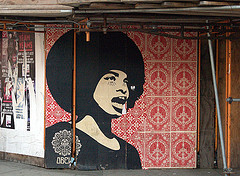
Shephard Fairey's Angela Davis (Boston, MA) by takomabibelot“The best lack all conviction, while the worst /Are full of passionate intensity.” – W.B. Yeats

I didn’t watch the State of the Union address last night; I was playing jazz with my friends.

When I was younger, I might have gotten into an argument about which was the more political act, championing the latter over the former. The presidential address to the legislature, I would have insisted, was little more than spectacle, a distraction. Believing that our leader’s words would in some fundamental way solve our problems or address the unease (Freud called it “discontent“) that haunts the citizenry of the most advanced and powerful nation on Earth was, I might have added, passive and infantile.

Moreover, the real machinations of government, I’d have pointed out, have little to do with speeches and posturing, driven as these machinations are by a complex competition for wealth and prestige between personal empires, well-funded interests and entrenched, institutional agendas. The words spoken for the assembled politicians and the atomized television viewers provide a surface reflecting both our insecurity and the hope we all harbor that someone (not us, for God’s sake!) is doing something to grapple with the myriad problems facing the massively intricate and over-developed system we inhabit, problems that beggar our comprehension.

Shunning the superficial solace of such civic theatricality, I would point out, I chose to lose myself in the the act of improvised creation and communal music-making. Rather than wrangling about how to protect freedom—which is only real and manifest in the free act itself—or provide for future generations—which, much like the future itself, do not exist—we were celebrating our freedom in the pursuit of the beautiful or the cool or the outrageous. And not for money or because we had to or to build our egos and dominate others, but because we sought that evanescent abandon where the aesthetic and the ecstatic converge—a realm beyond limit or contingency where true freedom, however fleetingly, dwells.

Of course, I’m older now and wouldn’t be so pretentious as to make such ludicrous claims. I was playing an instrument worth several thousand dollars through an amplifier that cost the same in a private studio built next to a million dollar home. The immediate neighbors had hosted a fund-raiser for the Republican Senator Scott Brown not seven months before. The freedom that we were celebrating was not hard-won, but bought and paid for. If we weren’t watching Obama, it was because whatever he was saying really didn’t matter to us. The class structure that supported our liberty provided us a comforting cocoon from within which we could indulge our be-bop whimsy, calmly assured that nothing this supposed socialist (now seeming ever more “business friendly”) was going to do or say would upset the apple-cart enough for us to be in the least concerned.

And if this situation gives me the blues, it’s because I believe, at a very basic level, that something about this set-up just isn’t right.

Image Source: takomabibelot.

Share

The Myth of Freedom

The New York Times ran a story on Friday about the spotlight Glenn Beck had cast on an “obscure CUNY professor,” Frances Fox Piven, and how this had attracted some very hostile attention from Beck’s followers. One fine fellow had left this comment on Beck’s site, The Blaze, “Somebody tell Frances I have 5000 roundas ready and I’ll give My life to take Our freedom back.”

The thing that struck me about this quote wasn’t the threat of gun-related violence but the idea that we need to take our freedom back. As I told a friend the other night, I can’t relate to this sentiment at all. Specifically, I don’t feel any less “free” today than I did before Barack Obama became president. Indeed, my friend responded that he felt more free since Obama was elected.

I’m not sure if my perception of the Tea Party (or Tea Party-ish Republicans) is simply a caricature invented by the liberal media, but it seems like this notion of freedom is near and dear to them and that they see the Obama presidency as an assault thereupon. However, I’m hard-pressed to name a freedom that has been lost during the last two years (and the “individual mandate” in the healthcare bill doesn’t count since it hasn’t gone into effect yet – though, even then, it’s really just a tax issue for those who don’t have insurance. Of course, freedom from taxation is a freedom we have never truly enjoyed).

Now, I love freedom just as much, if not more, than the next guy, but I also believe that freedom is relative and that actual freedom is different from formal freedom. We are all formally free, for example, to own property here in the United States, but one’s ability to actually exercise that freedom is constrained by one’s available resources. Similarly, we are formally free to pursue whatever career we wish, but our ability to do so depends on education, physical or intellectual abilities, available resources (again), and so on.

In other words, while we have not lost any fundamental formal freedoms over the last two (or more) years, the economic downturn has definitely impinged on the ability of millions to actually exercise said freedoms. Having lost my own job two years ago, I can relate to that feeling. However, I don’t understand how assaulting an economics professor, let alone trying her for treason, would restore that dimension of freedom.

Having said that, I do think that lashing out would at least give someone the sense that they were reclaiming the most fundamental freedom that humans enjoy: the freedom to act. Nevertheless, this raises another question about freedom and one that few have the existential wherewithal to adequately face let alone answer: If we are parts of the physical universe, and every thought or action cannot be separated from its physical underpinnings (think: neurochemistry), isn’t possible that our sense of freedom is itself an illusion imposed by the physical system that enables us to sense anything at all? What if, for instance, the evolutionary advantage that has made human beings the dominant species (at least among vertebrates) is not that we can act freely, but that we can believe we act freely?

In other words, the freedom to act that the lone gunman seizes could be, and in most cases probably is, just the symptom of an underlying neuro-chemical or otherwise conditioned physical state and thus not free in any sense of the word other than when physicists speak of an object, subject to the gravitational pull of another object, being in “free fall.”

And that’s a freedom that, frankly, no one can take from you.

Share

Formalism versus Fundamentalism

106303639_e5fce15c95_mAs some of you may recall, and many of you will not, Frances Fukuyama published a book in 1992 entitled, The End of History and the Last Man. Fukuyama’s thesis therein was that, with the ascendancy of societies combining a free market economy with democratic political institutions, history, understood quasi-dialectically as a series of increasingly dominant and effective social forms, had, as the title suggests, ended.

Fukuyama’s thesis was and is plausible because, like the scientific rationality which forms the third angle of modernity’s powerful triumvirate, the free market and democracy share a distinct formalism. Just as “science” offers not a set of beliefs about the world so much as a method for exploring and solving its many mysteries, “democracy” merely offers a way of formulating laws and maintaining a system of government, without stipulating their specific content, while the “free market” provides general guidelines for the organization of commerce and trade, indifferent to the existence of a particular enterprise or commodity.

This formal abstraction lends to science, the free market, and democracy, a kind of universal timelessness and along with it an aura of finality. At the same time, this formal emptiness, while appealing to the reformer, appalls the revolutionary; the reformer sees in this open-endedness the possibility of continuous improvement; the revolutionary sees it as a failure to instantiate the absolute.

Read the rest of this entry »

Share

Heidegger, Hölderlin, and Ronell – or – What Sticks in the Craw

2470380695_fd41f38779_mFunny what sticks in the craw.

I was doing a search for this pamphlet, Theory of Poverty, Poverty of Theory, a strange, Situationist tract that I bought in Berkeley long ago, when I came across the abstract for Avital Ronell’s essay, “On the Misery of Theory without Poetry: Heidegger’s Reading of Hölderlin’s ‘Andenken’.”

This essay, which I have not read, “[C]onsiders the tendency among young theorists to forget or repress poetry. As symptom, the aberrant dissociation of poetry from theory reflects an increasing technicization, not to say impoverishment, of critical language.”

I won’t go into why I believe Dr. Ronell finds the dissociation of poetry from theory aberrant, or why she paraleptically equates technicization with impoverishment (especially when one could just as easily see in the study of literary theory the root-cause of its student’s quite literal impoverishment).

Instead, I will focus, briefly, on the last line of the abstract, which reads, “I zero in on the figure of ‘dark-skinned women’ in the poem ‘Andenken’ to show how philosophy is tripped up by the permanent insurrection that poetry conducts.”

First of all, as you can see in my ad hoc translation of Hölderlin below, the women are “brown” [braun], not dark-skinned. The poem “takes place” in southern France, after all, where the grape-ripening sun also tans the limbs of those laboring in the fields twixt the Garonne and the Dordogne.

Secondly, I’m disturbed by the anthropomorphic dissociation of philosophy and poetry. Philosophy and poetry don’t conduct anything and suggesting they do removes them from the historical and material contexts in which they are conducted.

Finally, and along the same lines, I take issue with the figurative use of the term “insurrection” when speaking of Heidegger’s appropriation of Hölderlin, especially given the poet’s known Jacobin sympathies. Specifically, when insurrection becomes solely metaphorical, it is not the poetical that is repressed, but the political. Read the rest of this entry »

Share