I believe there is no legitimate power or illegitimate power. There is only power.
If you view a particular instance of power as ‘illegitimate,” it’s probably because you are on the other side of it.
Even legitimate power—say, the power granted a rightfully elected president by a constitution—depends on the power, pure and simple, whose exercise made said constitution an arbiter of legitimacy in the first place.
For example, the conquest of the territory now referred to as the United States of America bestowed legitimacy on the constitution of these United States. The only thing that bestowed legitimacy on the conquest was the fact that it occurred.
Were the conquered able to reverse their fate, the result, however gratifying, would be a power no more or less legitimate.
So, this morning, I was writing in my diary on the subway and I thought, “If I were to die, and someone found this book, what would I want them to know?”

- There are always more options than you realize or are actively considering.
- Giving is good.
- The system obeys its own logic. It is not a human logic.
- Our conscious perception of reality is a product of our nervous system. Ensuring that this product reflects the inputs as accurately as possible poses its own unique challenge. The other challenge is not always falling for this product and forgetting that we have conjured it forth.
- There’s nothing wrong with lying, per se. There are no rules, strictly speaking, but telling the truth, as difficult as that can be (given, in part, the difficulty of knowing the truth with certainty), is often easier to live with. It can also, at times, be downright heroic.
- You will be wrong about this and that. Admit it.
- Everybody is on some trip, though not everyone consciously so. This trip is an archetypical paradigm, a “way of living” that may have been sketched out explicitly for us (in church or school or work), or inferentially in song and story. It could be a power trip, an ego trip, a rebel trip, a mother trip, a father trip, a blues trip, a business trip, a science trip, a slacker trip, whatever. Recognizing you own trip qua trip can be helpful as can recognizing the trips of others. However, our overblown sense of individuality and personal novelty makes it difficult to accept that we are on a trip (we can, in defensiveness, immerse ourselves, lose ourselves, in it), so pointing it out won’t exactly win you any brownie points.
- Compassion towards others should be your default setting. Realize that they are on their trip or running their script, their programming, or simply living out their limitations, acting out, acting against something invisible, unconscious. And that they are doing so deliberately, as it may happen, as you yourself may be doing.
- Trips run the game.
- When somebody is coming at you, being rude and aggressive, it can be hard to remember that this is a trip they are on (it can be almost as difficult as realizing this is a trip you are on). You are going to feel like you need to defend yourself (in fact, you may actually need to), and you will want to respond with your own form of rude aggression. Choose another option.
- Feelings change. Life is longer than you expect. It’s all over before you know it.
- Be hard on yourself. Give yourself a break.
- There are infinite, though not unlimited, ways of doing anything.
We all carry around with us an idea of how the world works. This idea isn’t necessarily super detailed, but it does lay down the general guidelines for what we deem possible in the world and what we deem impossible.
For example: I am an atheist. This means that I don’t believe it’s possible that a supernatural being may, from time to time, intervene in human affairs (in response to a petitioning with prayer, for example), if for no other reason than that I believe such beings to be, all interventions aside, impossible.
Nevertheless, it doesn’t take much reflection to realize that no matter how sophisticated one’s notion of the world’s machinations, there is always something that one just doesn’t yet get or know about the world.
If we ever experience something like a revelation, then, what gives such revelation its jarring force is the way in which it reveals a fundamental and unsuspected truth about how the world works: that the imagined impossible is, astonishingly, possible.
And sometimes the realization of this possibility is nothing short of apocalyptic.
Everyone says, “Time is money.” But isn’t it more true that space is money?
I can’t increase the amount of time I have. In fact, I can’t possess time in any real sense because, in a very real sense, time doesn’t exist.
Time is not; it’s more like the is-ing or is-ness of everything. (I think a Nazi philosopher once wrote about this.)
By contrast, I can increase the amount of space (actual, physical space) that I own and control. In fact, through rents and the extraction of natural resources, this space can be fairly easily converted into money.
The notion that “time is money” is the expression of a wish: the wish for immortality. If time were something that we could accumulate and hoard, then we could, through force of will, stave off death, the end of our specific time.
But time doesn’t work that way.
Nor does money.
This is the second part of a textual reconstruction of a talk I gave on Benjamin at SUNY Albany.
After setting things up in the first part of my presentation on Benjamin and Twitter, and demonstrating how the cyberflâneur was alive and well on “the street” of Twitter, I went looking for Walter Benjamin there as well.
As it turns out, several people have set up accounts such as this, which intermittently posts Benjamin quotes, but someone also went to the trouble of setting up this short-lived parody account:
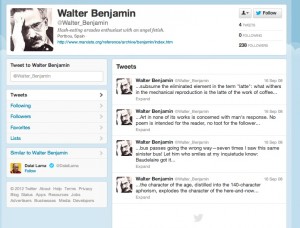
Aside from the comedic value of this account’s first tweet—”…the character of the age, distilled into the 140-character aphorism, explodes the character of the here-and-now…—I was struck by Twitter’s characterization, as you will note in the lower left-hand corner, of the Dalai Lama as “similar” to Benjamin.
Read the rest of this entry »
A friend pointed out that the most effective posts on this blog are the shortest.
I remember listening to a presentation at a business meeting and the speaker talking about the gross revenues of some client or other and our comptroller turning to me and saying, “A billion here, a billion there. Pretty soon you’re talking about real money.”
I was reminded of this joke when I heard an interview Terry Gross conducted with Woody Allen in which he described his life growing up in Flatbush and, noting that most of the parents back then had lived through the Depression, said, “Nobody had any real money and everybody had to work.”
The money we make from working is not “real.” Why? Because, if you stop working, it goes away.
Of course, the realness of money that remains whether you work or not is not a qualitative realness but a quantitative realness. Such accumulated wealth far outstrips the demands placed on it by maintaining a given life style.
It is also the case that if you have enough money to maintain a given life style and, at the same time, invest a portion of the remainder, you can actually increase your wealth at a pace greater than the pace at which your expenses drain said wealth.
Money that generates more money, is real money. Money that merely awaits its inevitable exhaustion, is not.
This is the first part of a textual reconstruction of the talk I gave on Benjamin at SUNY Albany.
1.The Death of the Cyberflâneur
In February 2012 Evgeny Morozov’s published an opinion piece in the New York Times entitled, “The Death of the Cyberflâneur.” Evgeny Morozov is a researcher and critic who wrote a book, The Net Delusion, in which he calls into question the cyber-utopian tendency to see an inherently liberating power in the web and social media.
With an eye sensitive to decline (Verfall) and the darker side of things, Morozov lamented in the Times the lost days when one would go on the web to “surf” and explore a sometimes surprising, even shocking world. Those were the days, in his view, of the cyberflâneur, the digital doppelgänger of the Parisian flâneur.
Today, he claimed, the web had found its Haussmann in the figure of Mark Zuckerberg. Facebook, according to Morozov, had brought an end to cyberflänerie. Facebook is essentially an infinitely extensible couch where we sit with our friends, exchanging photographs and found objects, texting, and commenting on the shows we’re watching. Facebook is the bourgeois interior realized in cyberspace and, hence, the grave of the cyberflâneur. After all, you can’t be a flâneur if you never leave the house. Read the rest of this entry »
Below is the text of a proposal I submitted to a conference entitled “Critical Speculations: Future Worlds, Perilous Histories, and Walter Benjamin Unbound” which will be held at SUNY Albany September 28-29, 2012
At the very end of his much-cited—and frequently misunderstood—essay on the work of art in the age of mechanical reproduction, Walter Benajmin wrote, “Humanity, which once upon a time in Homer served as an object of fascination for the gods, has now become one for itself.”
As with much of that essay, this sentence is more true now than when it was written. While one need look no further than the ubiquity of reality television to appreciate this, it is actually in social media, and especially on Twitter, that this process achieves its mass apotheosis. Indeed, Twitter is the contemporary, virtual manifestation of the Parisian Arcades that Benjamin spent the last years of his life studying.
For Benjamin, the Arcades served as an allegorical crystallization of the far-reaching and irreversible changes wrought by the accelerated rise of modernity. The same must be said of Twitter with regard to the post-modern, post-industrial, hyper-mediated present. Indeed, like a living, electronic reef, Twitter is composed of the accreted micro-sentiments of mankind. As such, it provides a protean, hyperdimensional portrait of contemporary subjectivity in all its most trivial, absurd and sublime glory.
Read the rest of this entry »
Where Does Information Come From?
I was following the #Resist44 hashtag on Twitter (which was an anti-Obama response to the #Gen44 hashtag) when I noticed an avatar that read, “WAR ON MARXIST THUGS.” Since I follow at least one other person who has declared a similar war, I clicked on the avi to learn more!
The bio pointed to a website called Resist the Lies, which curates rightist content. The curated article from March 18, 2012 was “Liberal Illiberalism” by the historian Victor Davis Hanson (whose book Culture and Carnage I found illuminating and highly recommend), a piece that sets out to show that certain elements of the liberal agenda as Hanson sees it—radical environmentalism, multiculturalism, affirmative action, illegal immigration (which I’m not sure any liberals advocate but, whatever)—are not just impractical, but “immoral.”
Reading Hanson’s essay, one thing that jumped out at me was a comment in the section devoted to the “unkind dogma” of multiculturalism, here defined as “the very notion that all cultures are professed equal, and those in the West often have a particular obligation to elevate illiberal and intolerant systems above their own in recompense for their supposedly ill-gotten prosperity and success.” Specifically, Hanson derides the press for failing to report that, “Sheikh Abdul Aziz bin Abdullah, the grand mufti of Saudi Arabia — not a minor voice in the world of Islam — announced that he wished, according to his reading of Koranic-inspired statute, that all the churches in the Gulf region be destroyed.”
Read the rest of this entry »