Matthew T Grant

Icon

Tall Guy. Glasses.

Publish and Perish

There are many reasons why my academic career didn’t pan out, but among them is undoubtedly the fact that I didn’t publish very much. For example, I never turned my dissertation on the Baader-Meinhof Gang into a book (though part of my research did end up in an obscure, Canadian journal called, Border/Lines).

When I did publish, it was essays like this one on the politics of gangsta rap.

Now, of course, I “publish” pretty much every day!

Life is so strange.

Man against Nature, Nature against God

2381419316_d1b8241e05_m-1Conservative critic Ross Douthat recently took James Cameron and Hollywood to task for rampant pantheist sympathies writing that pantheism “represents a form of religion that even atheists can support.”

While I believe he is mistaken to equate, as he does, pantheism with “nature worship” – the latter being more akin to polytheism or animism and the former meaning literally that God is too be found in the totality of the All, not “just” nature – I do agree that those who seek solace in natural wonders tend to be fairly selective about those parts of the natural world that they find wonderful, failing, for example, to hear the voice of God in cancer’s fatal malignancy or see the face of God in the blue sky’s indifference to atrocities unfolding ‘neath its broad, azure beams.

Though I sense Douthat’s tacit support of the Christian side of the equation, I appreciate that, in his argument against pantheism, he actually grants atheism a kind of tragic nobility:

Religion exists, in part, precisely because humans aren’t at home amid these cruel rhythms. We stand half inside the natural world and half outside it. We’re beasts with self-consciousness, predators with ethics, mortal creatures who yearn for immortality.

This is an agonized position, and if there’s no escape upward — or no God to take on flesh and come among us, as the Christmas story has it — a deeply tragic one.

Personally, what fills me with awe is the age-old human struggle to wrest sense from the senseless and to fashion purpose in the raging forge of entropic impermanence. That these efforts have about them the air of inescapable doom does indeed make them tragic.

That they can also result in moments, even epochs, of beauty, wisdom, freedom, and love, is truly divine.

Image Courtesy of Mark Cummins.

Epistemology versus Ethics

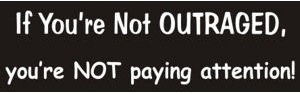
A local, recently gender-reassigned nanny drove a car which featured the following bumper sticker:

d87

While sympathetic to the sentiment expressed, believing, as I do, that reality, taken in the totality of its sordid, mundane, and astonishing details, is nothing if not outrageous, I felt nevertheless rankled.

Said rankling arose from my even stronger belief that the unstated logic of the proffered statement – “If you are not responding in a specific way, then you are not perceiving reality as it truly is” – serves as the logical underpinning of political, ideological, or religious fundamentalism in every form.

My work on Germany’s Red Army Faction (aka, The Baader-Meinhof Gang, a much cooler name, IMHO) led me to rebel against and reject “the unassailable logic of the next step,” as Norman Mailer called it in The Armies of the Night, insisting instead that there is no ethical norm inherent in the physical world, including, and this is the real scandal, the human world in all its perplexing complexity.

It is one of the benefits of being human that we can simply observe. While sense stimuli – a flashing light, a gunshot, an electrical shock – do indeed provoke hard-wired responses, and the body may involuntarily behave in a specific way based on the type of stimulus, this becomes less and less the case as we consider more involved levels of cognition.

Sunlight reflecting off a passing car may make us squint; recognizing the driver as our mortal enemy could make us cry out in fury or turn away or remain impassive. Conscious, attentive perception, thankfully and sadly, does not produce an automatic, programmed, and necessary response.

Still, to a certain way of thinking, the true outrage is human freedom.

The Joker

3288542484_d020daa685I may be late to the party, but I always have a good time.

See, I final caught Heath Ledger’s swan song in The Dark Knight and, like many people, his performance as the Joker really got under my skin.

Weird, damaged, and menacingly off-kilter, Ledger’s Joker embodies everything that Western rationalism apparently opposes and inevitably calls forth.

Unlike those shadowy figures who are thus labeled, this Joker is a terrorist in the most literal sense of the word: his sole aim is the production of a blithely dehumanizing, sanity annihilating, shockingly atavistic terror, specifically, the terror evoked by abject encounters with the chaotic void from which all reality issues and to which it inexorably returns.

The film gets evil precisely right when the Joker says, “The only sensible way to live in this world is without rules.” From the standpoint of law and order, in either a secular or non-secular sense, the idea that there is no absolute line dividing right from wrong or good from evil is intolerable. To celebrate those acts condemned by the dominant system leaves its hierarchy of values in place; to reject the legitimacy of any hierarchy at all is satanic rebellion.

(On a side note, I hear in the Joker’s ethos the pragmatic view that an unconditional flexibility – no fixed, dogmatic rules  – provides the key to adaptive survival. Of course, the amorality of adaptation, which is really just an opportunistic and even accidental “going with the flow,” is what truly frightens opponents of evolutionary theory.)

The film gets chaos precisely wrong. The violence and mayhem orchestrated by the Joker undeniably reflects the pervading notion of chaos as unpredictable, unassimilable, and overwhelming activity, but therein lies its error. True disorder is not characterized by a lot of something happening, but rather by a lot of nothing happening.

Indeed, the most accurate image of chaos we can muster is the heat death which awaits us as the entropic end of it all. When there is no longer any difference in energy states anywhere in the universe the pure state of chaos has been attained and it is, by definition, indistinguishable from nothingness. (Of course, this is why reviewers were unanimous in designating the Joker’s worldview “nihilistic.”)

By taking the side of the entropic decay and unstoppable disintegration of order, the Joker aligns himself with the grinding momentum of reality itself. It’s also why he is, as he says, “ahead of the curve,” and always one step ahead of Batman and the police; reality’s motion, its long march towards total dissolution is always one step ahead of us. We can never overtake it and are always, in the end and even before, overtaken.

Yet, it is this fact, the ultimate source of the Joker’s power, which also makes Batman’s adherence to his “one rule” truly heroic, though in the tragic sense. Belief in the timeless and unquestionable validity of “the rule” requires the denial of reality (that all rules are provisional, conventional, mutable ) and is, insofar, utter folly. Nevertheless, the faith expressed in devotion to “the rule” constitutes the stuff of valor and is, therewith, utterly human.

This raises the very question posed insistently and insidiously by the Joker as envisioned by Heath Ledger:

Does the unblinking acceptance of reality call for the overcoming of our humanity?

And if it does, should we?

Image Courtesy of Joan Thewlis.